
Estate Planning | Probate Law | Business Planning
Estate Planning | Probate Law | Business Planning
What Is a Charging Order and Why This Matters for Real Estate Investors in California
September 1, 2026 – Ali Talai

You’ve built a portfolio of California real estate investments and use one or more limited liability companies (LLCs) as part of your ownership structure. But what happens if a creditor obtains a judgment against you personally? Can the creditor take your LLC, control the real estate it owns, or intercept the income it produces?
When a personal creditor wants to collect a judgment from your financial interest in an LLC, California law provides a remedy known as a charging order. So, what is a charging order, and what could it mean for the real estate your LLC owns? A charging order places a lien on your transferable interest in the LLC and can redirect distributions you otherwise would receive to the creditor.
Although this means a creditor is already trying to collect a judgment against you, a charging order does not automatically give the creditor ownership or control of the LLC or the real estate it owns. Those limitations can provide a layer of asset protection for an LLC owner.
For California real estate investors, the distinction between what you own and what your LLC owns is central to understanding charging orders. Knowing what a creditor can and cannot reach can also help you evaluate whether your LLC is providing the asset protection you expect.
At a Glance
- A charging order places a lien on an LLC member’s transferable interest and can redirect distributions to a judgment creditor.
- The creditor doesn’t automatically become an LLC member or receive management or voting rights.
- California courts may appoint a receiver and, under certain circumstances, permit foreclosure of the charging order lien.
- Charging orders are only one layer of asset protection for real estate investors.
What Is a Charging Order in California?
A charging order is a court-ordered lien against a judgment debtor’s transferable interest in an LLC. Under California Corporations Code § 17705.03, the charging order can require the LLC to redirect distributions that otherwise would have been paid to the debtor.
Why does that matter for a real estate investor? Because there is an important difference between owning real estate personally and owning an interest in an LLC that owns the real estate.
If you personally own an investment property, you own the real estate. If an LLC owns the property, the LLC owns the real estate and you own an interest in the LLC. A personal creditor pursuing you is therefore looking at your LLC interest rather than simply treating the LLC’s property as though you own it directly.
For example, suppose your LLC owns a California investment property and a personal creditor obtains a $200,000 judgment against you for a debt unrelated to that property. The creditor can seek a charging order against your transferable LLC interest.
If the LLC later makes a $20,000 distribution that otherwise would have gone to you, that money may instead be paid to the creditor and applied toward the judgment. The creditor gains access to that economic benefit, but the charging order does not automatically make the creditor an LLC member or give the creditor management control over the company.
This separation between the LLC’s assets and the member’s ownership interest helps explain how LLCs can play a role in asset protection.
How Does a Charging Order Work Against an LLC?
A charging order is primarily a judgment enforcement mechanism. The basic process is:
- A creditor obtains a judgment against an LLC owner.
- The creditor identifies the debtor’s LLC interest as a potential source of payment.
- The creditor asks the court for a charging order against the debtor’s transferable interest.
- A lien attaches to the interest.
- Distributions that otherwise would go to the debtor may instead be paid to the creditor toward the judgment.
California Code of Civil Procedure § 708.320 also provides that serving the required notice of motion for a charging order creates a lien on the judgment debtor’s interest.
What Does a Charging Order Allow a Creditor to Do?
A charging order can give the creditor economic rights without automatically providing the rights of an LLC member.
The creditor may be able to:
- Place a lien against the debtor’s transferable LLC interest
- Receive distributions that otherwise would go to the debtor
- Ask the court for additional remedies authorized under California law
But the charging order does not automatically:
- Make the creditor an LLC member
- Provide management authority
- Provide voting rights
- Give the creditor control over the LLC’s business decisions
- Transfer ownership of real estate or other assets owned by the LLC
The charging order itself also doesn’t force the LLC’s managers to make a distribution simply because the creditor wants payment. However, that doesn’t mean the LLC owner can stop taking distributions and assume the creditor has no other options.
California law also allows a court to appoint a receiver when necessary to facilitate collection of distributions subject to the charging order. The receiver may make inquiries that the judgment debtor would have been entitled to make.
Why Do Charging Orders Matter for Real Estate Investors?
One of the easiest ways to understand the role of a charging order is to distinguish inside liability from outside liability.
Inside liability originates within the LLC or property. For example, a tenant may be injured at an apartment building owned by the LLC. A properly established and maintained limited liability company can help separate an owner’s personal assets from certain business debts and liabilities, although limited liability has important exceptions.
Outside liability originates with you personally. Perhaps a judgment arises from circumstances unrelated to the rental property. Your personal creditor then looks for assets and financial interests you own that could help satisfy the judgment.
A charging order addresses this second situation. The creditor isn’t pursuing the LLC because the LLC owes the personal debt. Instead, the creditor is attempting to reach your economic interest in the LLC.
Holding real estate through an LLC can create additional friction for a personal creditor. Instead of pursuing real estate held directly in your name, the creditor must address your interest in the legal entity that owns the property.
That doesn’t make the investment untouchable. It can, however, affect the time, procedures, uncertainty, and leverage involved in collection.
Can a Creditor Foreclose on an LLC Interest in California?
Yes, under certain circumstances. This is an important limitation on charging order protection in California. Charging orders are sometimes described as though a personal creditor can do nothing except wait indefinitely for distributions. California law is more nuanced.
Under California Corporations Code § 17705.03, if a court finds that distributions under the charging order will not pay the judgment within a reasonable time, the court may foreclose the charging order lien and order the debtor’s transferable interest sold.
The purchaser of the transferable interest does not automatically become an LLC member. The purchaser acquires the transferable interest and associated economic rights rather than automatically acquiring the member’s management rights.
California law makes the charging-order procedure the exclusive remedy for a judgment creditor seeking to satisfy a judgment from a debtor’s transferable LLC interest. However, that procedure includes more than redirecting distributions. The statutory framework permits remedies such as receivership and, when its requirements are met, foreclosure.
Charging order laws also differ among states, which is one reason real estate investors shouldn’t assume that information about an LLC formed or operated elsewhere necessarily describes California law.
How Much Charging Order Protection Does Your LLC Provide?
Simply having “LLC” after a business name doesn’t tell you how much LLC asset protection your structure may provide if a creditor claim occurs.
If you own California real estate investments, questions worth reviewing include:
- Is the property actually titled in the LLC intended to own it?
- Is the LLC a single-member or multi-member LLC?
- Does the operating agreement appropriately address ownership interests, transfers, and distributions?
- Are personal and business funds kept separate?
- Are leases, contracts, and bank accounts in the proper name?
- Does your liability insurance correspond with the property’s ownership and actual use?
- Is the LLC consistently treated as a separate business entity?
An LLC can provide limited liability, but it doesn’t prevent every form of personal liability. Your own conduct, personal guarantees, and other circumstances may expose personal assets. Failing to respect the LLC as a separate entity can also create arguments for piercing the corporate veil.
Does a Single-Member LLC Have Charging Order Protection?
A single-member California LLC can provide real estate investors with straightforward ownership and control, but investors shouldn’t assume that every business structure provides identical asset protection.
Charging orders also help prevent a member’s personal creditor from automatically acquiring management rights and disrupting the interests of other LLC members. Although a single-member LLC doesn’t involve unrelated co-owners, California’s charging-order statute still applies to a member’s transferable interest. The broader asset protection provided by a single-member LLC can depend on additional legal and factual issues.
This doesn’t mean a personal creditor can simply disregard a single-member LLC. It does mean that ownership, the operating agreement, creditor remedies, and the investor’s overall legal structure should be evaluated rather than assuming formation alone provides effective asset protection.
How Does a Charging Order Fit Into an Asset Protection Plan?
A charging order is one potential benefit associated with using business entities for asset protection, but no single legal structure can shield assets from every possible claim.
For real estate investors, effective asset protection strategies often involve layers. Depending on your circumstances, these may include LLCs or limited partnerships, appropriate liability insurance and umbrella policies, trusts, properly drafted operating agreements, and estate and tax planning. California law also provides statutory protection for certain types of assets and retirement arrangements under specific conditions.
The appropriate protection strategies depend on what you own and the risks you face. A sole proprietorship, for example, doesn’t create the same separation between the owner and business that a limited liability entity can provide.
Tax issues can also be relevant. When a creditor intercepts an LLC distribution or acquires economic rights associated with an ownership interest, the tax consequences can depend on how the entity is taxed and the particular circumstances. Asset protection and tax planning therefore shouldn’t be treated as completely separate decisions.
Most importantly, planning should take place before a lawsuit, judgment, or creditor problem develops. Moving assets after a claim arises can create additional legal issues and may expose transfers to challenge.
Frequently Asked Questions
Can a creditor force my California LLC to make distributions?
A charging order doesn’t, by itself, require an LLC to make a distribution simply because a creditor wants payment. It redirects distributions that otherwise would go to the debtor-member. However, California courts may appoint a receiver and use other remedies authorized by law to enforce a charging order.
Does a charging order give a creditor control of my LLC?
Not automatically. A charging order doesn’t by itself make the creditor an LLC member or provide management or voting rights. It initially gives the creditor rights associated with the debtor’s transferable economic interest.
Can a personal creditor take real estate owned by my LLC?
A charging order against your transferable interest doesn’t itself transfer the LLC’s real estate to your personal creditor. The LLC owns its assets, while you own an interest in the company. Different rules may apply when the LLC itself owes the debt or other legal grounds permit a creditor to pursue business assets.
Can a California creditor foreclose on my LLC interest?
Potentially. California law allows a court to foreclose the charging order lien when distributions won’t pay the judgment within a reasonable time. The purchaser of the transferable interest doesn’t automatically become an LLC member.
Is an LLC enough to protect my real estate investments?
An LLC can provide limited liability and serve as an important asset protection layer, but forming one doesn’t address every risk. Insurance, property ownership, operating agreements, entity maintenance, personal liability, and the structure of your overall portfolio can all affect your exposure.
Find Out How Your LLC Structure May Hold Up Under Pressure
Owning real estate through an LLC can change how a personal creditor approaches your investments, but having an LLC doesn’t necessarily mean your assets have the protection you expect. Property ownership, operating agreements, insurance, entity maintenance, and the way these pieces work together can become especially important when a creditor begins looking for ways to collect.
At Talai Law Offices, California asset protection lawyer Ali Talai, Esq., LL.M., works with real estate investors to evaluate how LLCs, property ownership, insurance, trusts, tax planning, and other asset protection strategies fit together. He also teaches real estate investors about charging orders, LLC structuring, and layered asset protection strategies, bringing a practical perspective to how these legal tools may affect creditor claims and collection efforts.
If you’ve built equity in California investment properties, reviewing your existing structure before a creditor problem develops can help identify potential weaknesses and determine whether your current plan reflects your portfolio and long-term priorities.
Call (818) 285-2850(818) 285-2850 or complete the firm’s confidential online form to schedule your consultation.
At Talai Law Offices – we’re your attorneys for life.
Copyright © 2026. Talai Law Offices, Inc. All rights reserved.
The information in this blog post (“post”) is provided for general informational purposes only and may not reflect the current law in your jurisdiction. No information in this post should be construed as legal advice from the individual author or the law firm, nor is it intended to be a substitute for legal counsel on any subject matter. No reader of this post should act or refrain from acting based on any information included in or accessible through this post without seeking the appropriate legal or other professional advice on the particular facts and circumstances at issue from a lawyer licensed in the recipient’s state, country, or other appropriate licensing jurisdiction.
Talai Law Offices, Inc.
6300 Canoga Ave, Suite 550
Woodland Hills, CA 91367
(818) 285-2850(818) 285-2850
https://talailawstg.webteam.ai/
Contact Us
The Highest Quality of Legal Service

Estate Planning, Business Planning, and Probate Attorney
Ali Talai, Attorney at Law
schedule a call todayBlogs
Related Blog Posts
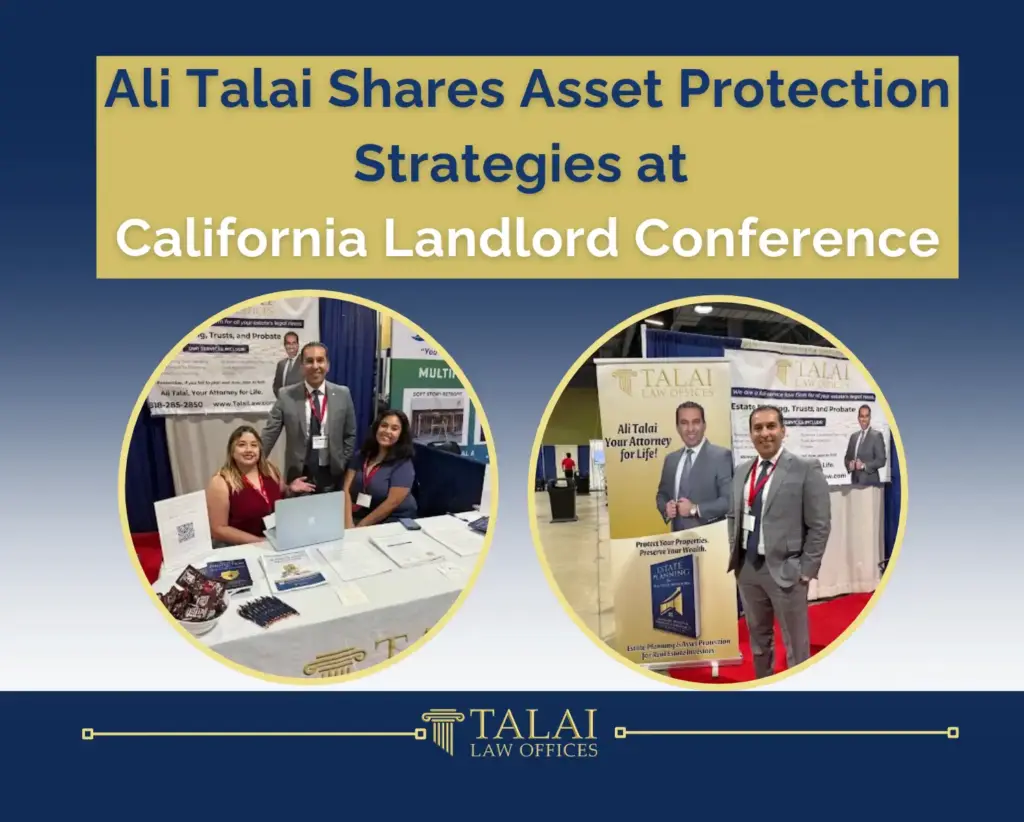
LONG BEACH, California — Talai Law Offices, Inc. is pleased to announce that its founder and principal attorney, Ali Talai,…

When you create a trust, choosing its name may seem like a minor detail compared with deciding who will serve…

You created your trust to make things easier for the people you care about. At the time, your wishes were…

SUBSCRIBE TO OUR NEWSLETTER
Stay Informed and Connected
Stay Informed By Signing Up For Our Newsletter!
Contact Us Today!
Contact Us, & We’ll Guide You Through Your Next Steps!
<div class="et_pb_code_inner"><!-- Start Lawmatics Embedded Snippet -->
<iframe frameborder="0" scrolling="no" src="https://app.lawmatics.com/forms/embedded/51546b74-8f7f-400d-809d-f5cc1d3ad4f1" id="iFrameResizer0" style="width: 1px; min-width: 100%; overflow: hidden; height: 1167px;"></iframe><script id="lm-embedded-script">
!function(e,t,n,a,s,c,i){if(!e[s]){i=e[s]=function(){i.process?i.process.apply(i,arguments):i.queue.push(arguments)},i.queue=[],i.t=1*new Date;var o=t.createElement(n);o.async=1,o.src=a+"?t="+Math.ceil(new Date/c)*c;var r=t.getElementsByTagName(n)[0];r.parentNode.insertBefore(o,r)}}(window,document,"script","https://navi.lawmatics.com/intake.min.js","lm_intake",864e5),lm_intake("51546b74-8f7f-400d-809d-f5cc1d3ad4f1");
</script>
<!-- End Lawmatics Embedded Snippet -->
</div>